Supervision for counsellors working with trauma
Held Online with Sex & Trauma Counsellor, Kellie Sheldon
Working with trauma asks a lot of you. The work is layered, at times confronting, and doesn’t always resolve neatly by the end of a session. And sometimes what comes up for your client starts to live in you too.
If you’re supporting clients through childhood trauma, sexual trauma, dissociation, sexuality, kink, or ENM relationships — and you’re drawing on frameworks like parts work, EMDR, somatic approaches, psychodynamics, or attachment theory — supervision needs to be a place where you can slow down and bring what’s actually happening in the counselling room and within you.


Welcome to supervision
This isn’t tick-the-box supervision.
This is a kink-aware, trauma-informed, and non-pathologising space where you can bring the hard stuff — the cases that stay with you, the moments you’re not proud of, and the parts of the work that no one talks about.
This supervision welcomes counsellors at every stage — whether you’re fresh out of training and finding your feet, or you’ve been practicing for years and want somewhere to go deeper. You don’t need to know what you’re doing wrong before you arrive. That’s what we’re here to figure out together.

Together we will:
- Make sense of complex stories, experiences, and emotions
- Stay grounded when the work gets heavy
- Explore stuckness without shame
- Explore what shows up for you in the room
- Bring your clinical knowledge and your humanity — both matter here
- Explore how to make your private practice grow and be seen


You’re welcome to bring:
- The session you keep replaying in your mind
- Moments where you wondered if you missed something, or moved too fast
- Uncertainty about pace, boundaries, safety, or capacity
- Ethical questions and clinical decision-making
- What this work is stirring in you, not just in your clients.
Nothing needs to be tidy before you arrive.
Who I work with
I primarily provide clinical supervision for counsellors and other mental health practitioners and therapists in Australia, including:
- Counsellors seeking ACA-aligned supervision
- Counsellors working with clients around sexuality, kink, ENM, or sexual trauma who want a supervisor who gets it
- Counsellors supporting clients whose trauma started early and runs deep
- Therapists using EMDR or parts-based approaches
- Counsellors in private practice who want supervision that understands the reality of running your own practice
- Counsellors supporting clients with dissociation (including DID), attachment trauma, or complex developmental histories.
My supervision training is through Step Up, a recognised clinical supervision program. I am also an accredited EMDR practitioner with EMDRAA.
If you’re a counsellor looking for a supervisor who understands trauma work, and who values relational depth over box-ticking, you’re likely in the right place.
If you’re unsure whether this is the right supervision for you, you’re welcome to reach out.
Contact Us
Pricing
Group 2 hours
$110 (inc GST)
Small group supervision offers shared thinking, learning, and relational connection. Groups are intentionally small (maximum of 4 practitioners/participants per group) to allow depth, safety, and meaningful reflection.
This form of group clinical supervision supports shared learning while still honouring the complexity of individual client work. It’s ideal if you value collaborative learning, reflective dialogue, and connection with a community of other practitioners navigating similar experiences.
Group Supervision Details:
- Online group supervision
- First Thursday of each month
- 9:00am (AWST)
- 2 hours
- Maximum 4 participants
Individual 60 mins
$185 (inc GST)
Individual supervision is available by enquiry.
This may suit you if you’re:
- Working through complex or high-risk presentations
- Seeking EMDR-focused consultation (hours not counted towards accreditation)
- Holding significant emotional impact from the work
- Group supervision isn’t an option for you.
Sessions are tailored to your clinical context, experience level, and professional requirements.
Enquire Now
What we can focus on in supervision
Group supervision is particularly suited to practitioners working with:
- Complex PTSD and PTSD
- Dissociation and structural dissociation
- Sex, intimacy and sexuality
- Childhood sexual abuse and sexual trauma
- Attachment and developmental trauma
- EMDR (including case consultation)
- Somatic approaches
- Parts-based approaches
- Kink, BDSM, and alternative relationship dynamics
- Ethical non-monogamy and polyamorous relationship dynamics
- Generational and intergenerational trauma.
- Vicarious trauma and therapist self care
You don’t need to arrive with a neat case formulation. Bring the mess — that’s what supervision is for.
Meet Kellie
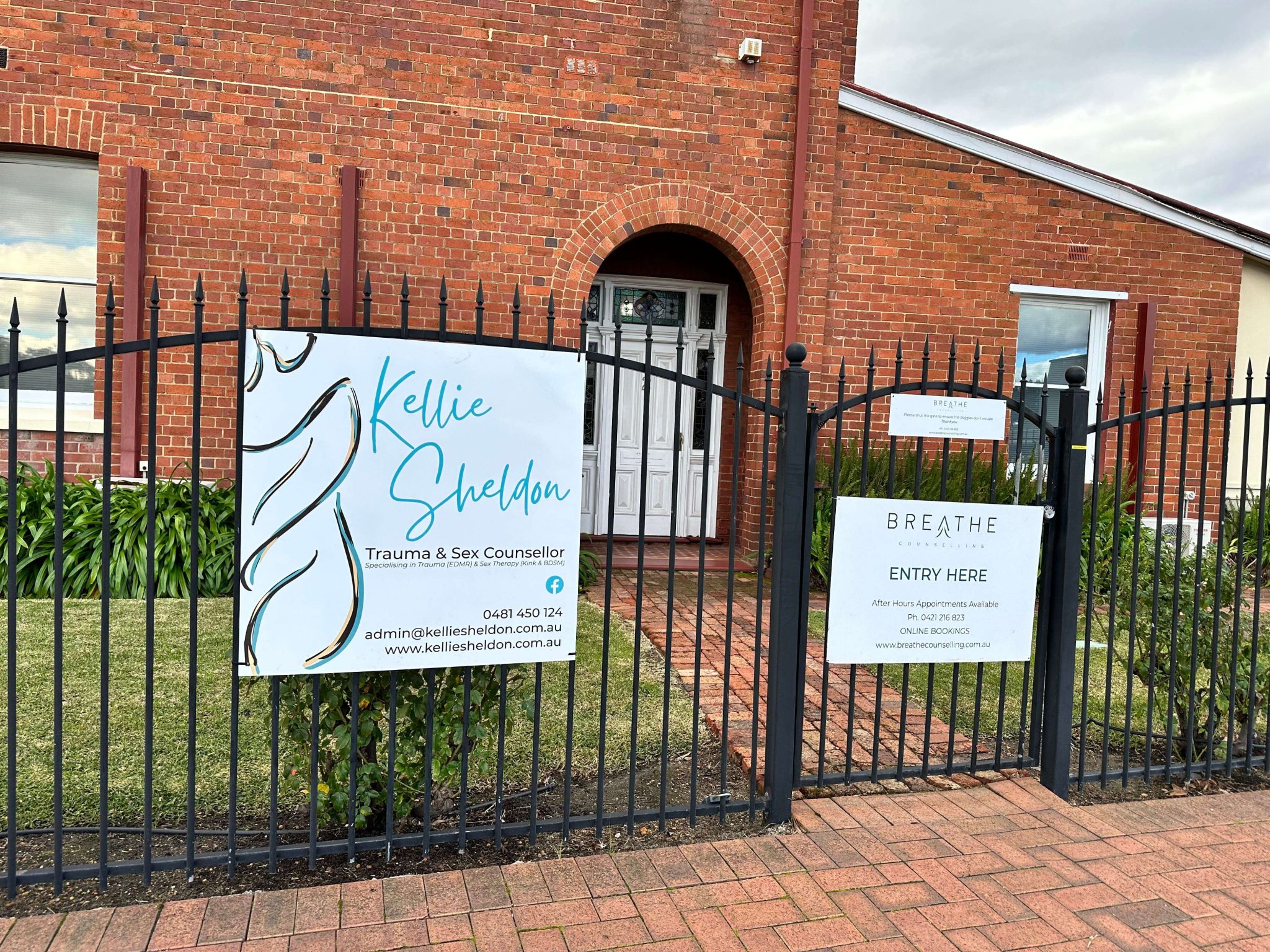
I’m Kellie Sheldon, trauma and sex counsellor, Accredited EMDR practitioner, private practice owner, and clinical supervisor based in Perth, Australia.
I’ve been in private practice for over four years, and most of my work sits with complexity: childhood and sexual trauma, dissociation, attachment wounds, parts work, EMDR, and relational dynamics that don’t always fit neatly into mainstream frameworks. Supervision, for me, is a relational practice.
It’s a place to slow down, think together, and make sense of what’s happening, both clinically and personally, when you’re working with trauma.
I’m especially aware of how this work lives in the body. We don’t just “think” our way through trauma therapy; we feel it, carry it, and sometimes absorb it. Supervision needs to hold that too — otherwise it’s just box-ticking with good intentions.
I spend a lot of time learning alongside and from psychologists, and my own supervisor is a registered psychologist. I bring that depth into supervision without the clinical chill — my philosophy is to meet people where they are, not where the DSM says they should be.
- Bachelor of Psychology (major) and Counselling (minor)
- Graduate Diploma of Counselling and Psychotherapy
- Master of Counselling Practice
- EMDR Accreditation with EMDRAA membership
- PACFA Member
- Step-Up Clinical Supervision Training
My approach to supervision
When I offer supervision, I’m not looking for you to perform or have everything figured out.
I’m interested in:
- How the work is landing for you
- Where things feel stuck, heavy, or unclear
- What your nervous system is doing alongside your clinical decisions
- How we can support both ethical practice and your long-term wellbeing
My approach is trauma-informed, developmentally oriented, and based in relational safety. I work with curiosity rather than correction, and I aim to create a judgement-free space where honest reflection is possible.
This is particularly important when working with complex presentations like CPTSD, dissociation, sexual trauma, EMDR, or parts-based therapy, where there are rarely simple answers.